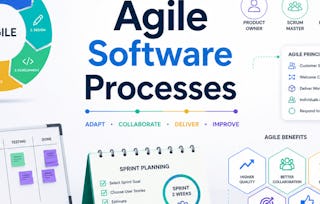
This course delves into Agile software development, offering students a practical understanding of the software development life cycle (SDLC) with a strong emphasis on Agile methodologies. Throughout the program, participants will explore the technical, cultural, and social aspects of agility, empowering them to navigate the complexities of modern software development.

Gain next-level skills with Coursera Plus for $199 (regularly $399). Save now.

Skills you'll gain
- Scaled Agile Framework
- Agile Methodology
- Communication
- Project Planning
- Sprint Retrospectives
- Prioritization
- Scrum (Software Development)
- Team Building
- Agile Software Development
- Conflict Management
- Agile Project Management
- Leadership
- Software Development
- User Story
- Kanban Principles
- Sprint Planning
- Lean Methodologies
- Software Development Life Cycle
- Backlogs
Details to know

Add to your LinkedIn profile
January 2026
20 assignments
See how employees at top companies are mastering in-demand skills

There are 7 modules in this course
In this module, you'll explore Scrum and Kanban, and evaluate their pros and cons to find which suits your projects best. We'll discuss how Agile methods boost teamwork and collaboration within organizations. You'll also learn to develop an Agile project plan focusing on setting clear goals, defining the project's scope, and understanding its limitations. By the end, you'll be ready to use Scrum and Kanban effectively in professional settings, improving both teamwork and project management.
What's included
4 videos6 readings2 assignments
In this module, we're diving into how digital tools can make a difference in the Scrum framework. Digital tools help teams work together better and manage Agile software development projects efficiently. You'll learn more about Scrum artifacts and how to use them in the real world to make Scrum practices stronger. We'll look at how effective these artifacts are in a physical workspace and determine where improvements can be made.
What's included
1 video4 readings3 assignments
In this module, we will explore different Agile methodologies used to enhance efficiency and adaptability in software projects. We will cover Scrum, Extreme Programming (XP), Lean, and Kanban. Lean Thinking will help you streamline projects, focus on essentials, and eliminate waste. Kanban will allow you to improve work management. Extreme Programming (XP) focuses on collaboration, with Pair Programming being a key component that helps achieve higher quality and customer satisfaction. Scrum, on the other hand, enhances teamwork through sprints and regular check-ins which promotes adaptability. By the end of this week, you will have mastered Agile methods to improve project outcomes and teamwork. These skills will help you create flexibility, efficiency, and responsiveness in future projects.
What's included
2 videos7 readings3 assignments
This week, we're diving into Scaled Agile Frameworks (SAFe). We'll look at its different configurations like Essential, Large Solution, and Portfolio, and examine how each one can influence a company's approach to developing software. Our goal is to give you the knowledge and understanding needed to suggest the most suitable SAFe configuration for a specific business situation. We'll also check out how well SAFe competencies help in keeping everyone in the organization on the same page, and why SAFe might be a better choice in certain companies when compared to other frameworks.
What's included
1 video4 readings3 assignments
In this module, you will learn to divide a project into smaller sprints and add value at each step. You'll discover how to prioritize tasks based on customer needs and feedback, to select the most valuable project tasks. You’ll explore how to identify and adapt to changing needs and priorities in Agile projects to keep your project flexible. Additionally, you will learn how feedback sessions like daily stand-ups, sprint reviews, and retrospectives, are essential to refine and improve the final product.
What's included
1 video4 readings3 assignments
In this module, we’ll explore what it takes to be a great leader. We will develop your leadership and team management skills. You'll learn about effective communication, how to motivate others, and how to make strategic decisions. We'll learn how to delegate tasks well and make sure you're able to support your team. We'll focus on planning and decision-making strategies to boost the productivity and impact of projects. Moreover, we'll address how to manage team stress, pinpoint common causes of stress, and give practical ways to reduce it. This will help you maintain a healthy and thriving team atmosphere in the future.
What's included
3 videos1 reading3 assignments
In this module we're going to look at how conflicts happen in projects and what causes them. You'll learn about different ways to handle and solve these conflicts within your team and make sure everyone works well together. We'll also explore the importance of effective communication and how this can make a difference in the project's success. By the end of this week, you'll be better at dealing with problems, using the right methods to solve them, and making sure everyone is on the same page. This will help your team work better together and help you achieve your project goals more smoothly.
What's included
1 video3 readings3 assignments
Instructor

Offered by
Why people choose Coursera for their career


Open new doors with Coursera Plus
Unlimited access to 10,000+ world-class courses, hands-on projects, and job-ready certificate programs - all included in your subscription
Advance your career with an online degree
Earn a degree from world-class universities - 100% online
Join over 3,400 global companies that choose Coursera for Business
Upskill your employees to excel in the digital economy
Frequently asked questions
To access the course materials, assignments and to earn a Certificate, you will need to purchase the Certificate experience when you enroll in a course. You can try a Free Trial instead, or apply for Financial Aid. The course may offer 'Full Course, No Certificate' instead. This option lets you see all course materials, submit required assessments, and get a final grade. This also means that you will not be able to purchase a Certificate experience.
When you purchase a Certificate you get access to all course materials, including graded assignments. Upon completing the course, your electronic Certificate will be added to your Accomplishments page - from there, you can print your Certificate or add it to your LinkedIn profile.
Yes. In select learning programs, you can apply for financial aid or a scholarship if you can’t afford the enrollment fee. If fin aid or scholarship is available for your learning program selection, you’ll find a link to apply on the description page.
More questions
Financial aid available,